
Taking an AI Platform to Production: What REISER does (and Why "getting It running" isn't enough)
You have a prototype that works locally. Or an application that “runs,” but occasionally hangs, responds slowly, or throws errors no one can explain with any confidence. Or perhaps you have an AI agent — developed in-house or by a vendor — that has never truly been deployed to production in a structured way.
These are exactly the scenarios where REISER steps in.
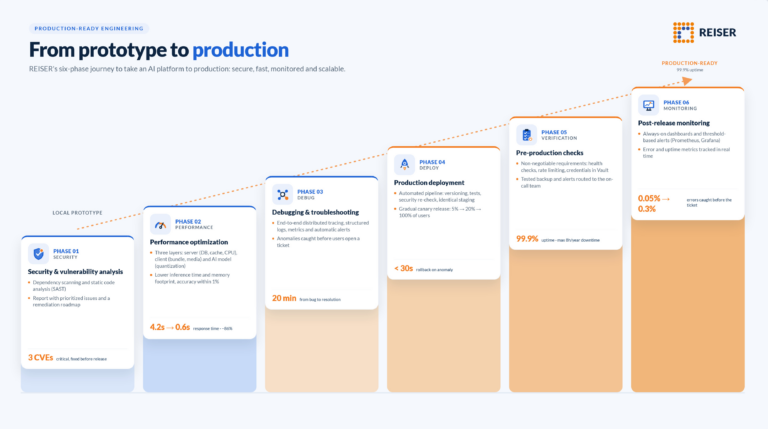
What “taking a platform to production” actually means
In technical terms, the goal is a production-ready state: a system that is secure, performant, monitored, and scalable enough to serve real users continuously, without requiring a technician to babysit it manually.
The gap between a working prototype and a production-ready platform is routinely underestimated. In practice, it is the difference between a car that drives fine in a parking lot and one that passes a road safety inspection.
REISER works precisely in that gap.
The six-phase process: what actually happens
1. Security and vulnerability assessment
Before touching performance, the platform is checked for open vulnerabilities. This is not a bureaucratic formality — it is the mandatory starting point.
Real-world example: a manufacturing company has built an in-house web application for maintenance management. The app works, but its software dependencies have not been updated in 18 months. An automated scan identifies three libraries with known vulnerabilities (published CVEs), including one that allows unauthorized database access. The issue is remediated before release — not after.
REISER uses dependency scanning (OWASP, Trivy) on critical endpoints and static application security testing (SAST). The output is a prioritized findings report and a clear remediation roadmap.
2. Performance optimization (fine-tuning)
A slow platform loses users and drives up costs. The problem is rarely the hardware — it is usually suboptimal configuration, inefficient queries, or resources loaded without any strategy.
Real-world example: a logistics platform with an AI module for delivery time forecasting takes 4.2 seconds to respond to each request. After model optimization (quantization), database query tuning, and the introduction of a multi-layer caching system, response time drops to 0.6 seconds. The platform becomes genuinely usable in an operational context.
Optimization covers three layers: server-side (database, cache, CPU), client-side (bundling, media, progressive loading), and — for AI systems — the model itself, using techniques that reduce inference latency and memory footprint while keeping accuracy within 1% of the original model.
3. Debugging and issue resolution
Bugs in production carry a direct cost: system downtime, blocked users, open support tickets. Identifying them quickly requires observability tooling, not just logs.
Real-world example: a B2B web application generates intermittent errors that never reproduce in testing. End-to-end distributed tracing reveals that the root cause is a third-party microservice that exceeds its response time limits only under load. The bug was real — but invisible without the right tooling.
Continuous monitoring (metrics, structured logs, automated alerts) makes it possible to catch anomalies before users ever report them. You do not wait for something to break — you see the problem coming.
4. Production deployment
The release moment is the highest-risk point. A poorly managed deploy can cause downtime, data loss, or regressions that are difficult to trace.
Real-world example: a cybersecurity company needs to update its audit platform without interrupting service for existing clients. A canary release strategy is used: the new code is initially rolled out to 5% of users. If metrics remain stable after 30 minutes, rollout proceeds to 20%, then to 100%. In the event of anomalies, rollback is triggered in under 30 seconds — with no visible impact on clients.
The deployment pipeline is fully automated: versioning, testing, security re-checks, and a staging environment that mirrors production exactly. No manual releases, no “fingers crossed.”
5. Pre-production checklist
Before every release, REISER verifies a set of non-negotiable requirements: active health checks, overload protection (rate limiting), secure secrets management (HashiCorp Vault), a tested backup plan, and an alerting system configured and routed to the on-call team.
If any of these requirements is not met, the deploy does not proceed. This is not bureaucracy — it is why a 99.9% uptime target is actually achievable.
In practice: 99.9% availability means a maximum of 8 hours of downtime per year. Without this phase, that figure is not a commitment — it is just an expectation.
6. Post-release monitoring
The work does not end at go-live. Live dashboards, configurable threshold alerts, and error and availability metrics monitored in real time via Prometheus and Grafana.
Real-world example: the day after a release, monitoring detects an increase in the error rate on a specific endpoint from 0.05% to 0.3%. The alert reaches the engineering team before any user opens a support ticket. The issue is isolated and resolved within 20 minutes.
Why this matters for your business
Regardless of sector — manufacturing, logistics, cybersecurity, professional services — the question most IT managers face is always the same: we have something that works, but we are not confident it will hold.
The concrete risks of skipping this process are:
- Unplanned downtime with direct impact on end clients
- Data breaches caused by outdated software dependencies
- Uncontrolled cloud costs from inefficient configurations
- Scalability bottlenecks when traffic grows
- Long-term maintainability issues due to lack of documentation and standards
The REISER process turns these uncertainties into measurable guarantees.
The tools — with no vendor lock-in
REISER works with industry-standard stacks: Docker and Kubernetes for containerization; AWS, GCP, and Azure as cloud providers; GitHub Actions and GitLab CI for CI/CD automation; Prometheus and Grafana for monitoring; HashiCorp Vault for secrets management.
No proprietary systems. No forced vendor dependency. Everything documented and transferable.
How to take the first step
The initial assessment is free. After submitting the form, a REISER engineer responds within 24 hours to gather project details. The output is a written preliminary assessment covering: the platform’s current state, the primary risk areas, and a scope estimate.
An NDA can be signed before the assessment takes place. No commitment is required until you decide to proceed.
Average time for a full engagement: 2 to 6 weeks, depending on the current state of the platform.
Explore REISER’s web platform and AI services maintenance and optimization offering
Frequently asked questions
Can you optimize an AI model without losing accuracy?
Yes. Quantization and distillation techniques reduce inference latency and memory usage while keeping accuracy within 1% of the original model. Every intervention is documented with before-and-after metrics.
Do you work with hybrid on-premise/cloud infrastructure?
Yes. REISER manages on-premise, cloud, and hybrid environments, including multi-cloud scenarios with a dedicated disaster recovery strategy.
How long does the 99.9% availability guarantee apply?
99.9% availability is a continuous operational target, maintained through a combination of zero-downtime deployments, active monitoring, and a rollback plan executable in under 30 minutes.
REISER Informatica · Software development and IT consulting for enterprises
→ Request a free platform assessment
info@reiser.it
+39 0289604195